Who explored the caves
Martel and Lake Martel
Who explored the Cuevas del Drach: the early maps, Édouard-Alfred Martel's 1896 expedition, the Archduke who backed him and the lake that took his name.
Choose a date for the Drach caves ↗Quick answer
Lake Martel is named after Édouard-Alfred Martel, the French speleologist who explored the Cuevas del Drach in September 1896 with Louis Armand, under the protection of Archduke Ludwig Salvator. The German officer Friedrich Will had drawn the first known map in 1880. The cave's own history page counts Martel as the father of modern speleology.
Before Martel
The caves were known long before the explorers arrived. Some historians place the first written mention in a message from Roger de Rovenach, the island's governor, to the mayor of Manacor, with 1338 the date usually given, though the identification is not certain. The name Drach, meaning dragon, appears in print in the 17th century, in Dameto's history of the Kingdom of Mallorca. From the late 18th to the early 19th century, historians and geographers cited the cave, among them Cardinal Despuig and Joaquín María Bover.
Friedrich Will's map
In 1880 the German officer and entomologist Friedrich Will drew the first known map of the caves, at the invitation of Archduke Ludwig Salvator. Will mapped the White and Black caves, according to Wikipedia. In 1888 the French artist Gaston Vuillier visited, and in 1889 he published an account of the Balearic Islands that described the cave in detail. Jules Verne mentions the caves in his novel Clovis Dardentor.
The Archduke behind it all
Archduke Ludwig Salvator of Austria was born in Florence in 1847 and first came to Mallorca in 1867. The island became his base for life. His major work, Die Balearen, appeared from 1869 and covers the wildlife, plants, history and customs of the islands. He invited Will, and he gave Martel his protection. The cave's history page says Martel came on Vuillier's advice and under the Archduke's protection.
Martel arrives, 1896
Édouard-Alfred Martel was born in Pontoise on 1 July 1859 and trained as a lawyer, but he gave up the law in 1899 to concentrate on cave research. In 1895 he founded the Société de Spéléologie in Paris, the first organisation devoted to cave science. He arrived on Mallorca in September 1896, on Vuillier's advice. With Louis Armand he found new cavities and a large underground lake, which now carries his name. Wikipedia describes it as the largest underground lake known at the time.
What the explorers found
Wikipedia says Martel's expedition found two more caves beyond the two Will had mapped, so the system now counts four: the Black Cave, the White Cave, the Cave of Luis Salvador and the Cave of the French. Martel drew a schematic plan of what he found. Later a new entrance, facing Cala Murta, became the usual way in for visitors. The sources disagree on the lake's length, giving 115, 117 or 177 metres, so check the figure's source before you repeat it.
Martel's other caves
Mallorca was one stop in a long career. According to Wikipedia, Martel explored thousands of caves in France and abroad. His list includes the Bramabiau gorge and the Dargilan cave in 1888, Padirac in 1889, which he later bought and turned into a show cave, and Marble Arch in Northern Ireland and Gaping Gill in Yorkshire in 1895. His books include Les Abîmes in 1894 and La Spéléologie in 1900. Seen against that record, the Drach lake was one find among many, though the largest underground lake known at the time.
From exploration to attraction
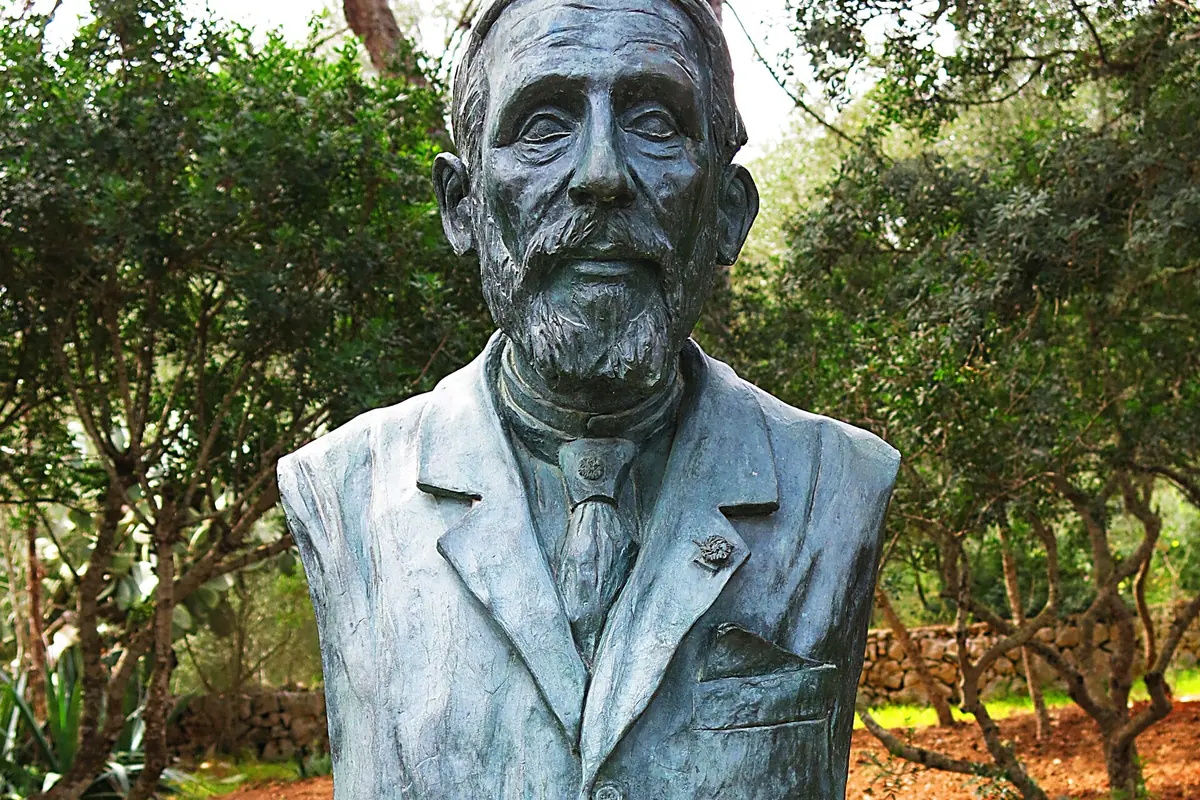
Turning the caves into an attraction came in the 20th century. According to German Wikipedia, Juan Servera Camps began developing them commercially in 1922, and Carles Buïgas lit them in the 1930s. The public opening followed in 1935, the year from which the cave dates its concert. A bust of Martel and a monument to Servera Camps stand near the caves today.
Who this isn't for
Readers after practical advice alone can skip this history: the visit works without it. But if you like to know who found a place, the story of a lawyer who became a cave explorer, an archduke who wrote about an island and a German officer who drew a map adds something to the walk down to the lake. The walk is just as good without it.
Frequently asked questions
Who found the Drach caves?
Nobody found them first in the strict sense: they were known for centuries. Édouard-Alfred Martel explored them in 1896 and found the lake that bears his name.
Who was Édouard-Alfred Martel?
A French lawyer turned speleologist, born in 1859. He founded the Société de Spéléologie in 1895 and is called the father of modern speleology.
Who was the Archduke?
Ludwig Salvator of Austria, who settled on Mallorca in 1867 and wrote Die Balearen. He invited Friedrich Will and protected Martel's expedition.
Sources